The connection is compatible with Mini DisplayPort. Converting You can convert some of these cables into others. For example, DVI and HDMI are generally convertible using a simple adapter. Shop for mac dvi cable at Best Buy. Find low everyday prices and buy online for delivery or in-store pick-up. One problem that Mac 911 can always count on: The complexities of using old Apple monitors to work with new USB-C-equipped Macs. The 2015 and later MacBook uses USB-C for USB 3 and DisplayPort. DAT 5730D Mini DVI to HDMI Adapter. Type: Mini DVI to HDMI Adapter Changer Type: Mini DVI Male to HDMI Female Color: White Specifications: Designed for Apple iMac, Macbook, and 12' Powerbook G4 with mini DVI connection, the Mini DVI to HDMI Adapter allows quick and easy connection between HDMI devices. Model #: 5730D Item #: N9036 Return Policy: Standard Return Policy. Buy PTC Mini-DVI to HDMI Adapter with 6ft HDMI Cable for Macintosh: HDMI Cables - Amazon.com FREE DELIVERY possible on eligible purchases.
| Type | Digital and analog computer video connector | ||
|---|---|---|---|
| Production history | |||
| Designer | Apple Inc. | ||
| Manufacturer | Apple Inc. | ||
| Superseded | Mini-VGA | ||
| Superseded by | Mini DisplayPort (October 2008) | ||
| General specifications | |||
| External | yes | ||
| Video signal | As DVI | ||
| Pins | 32 | ||
| Pin out | |||
| A female mini-DVI socket | |||
| Pin 1 | Dat2_P | Data 2 + | |
| Pin 2 | Dat2_N | Data 2 - | |
| Pin 3 | Dat1_P | Data 1 + | |
| Pin 4 | Dat1_N | Data 1 - | |
| Pin 5 | Dat0_P | Data 0 + | |
| Pin 6 | Dat0_N | Data 0 - | |
| Pin 7 | CLK_P | Clock + | |
| Pin 8 | CLK_N | Clock - | |
| Pin 9 | DGND | ||
| Pin 10 | DGND | ||
| Pin 11 | DGND | ||
| Pin 12 | DGND | ||
| Pin 13 | DGND | ||
| Pin 14 | DGND | ||
| Pin 15 | DGND | ||
| Pin 16 | DGND | ||
| Pin 17 | +5 V | ||
| Pin 18 | DCC_DAT | ||
| Pin 19 | spare | ||
| Pin 20 | BLUE | Analogue blue | |
| Pin 21 | not installed | ||
| Pin 22 | GREEN | Analogue green | |
| Pin 23 | not installed | ||
| Pin 24 | RED | Analogue red | |
| Pin 25 | Detect | ||
| Pin 26 | DCC_CLK | ||
| Pin 27 | spare | ||
| Pin 28 | DGND | ||
| Pin 29 | HSYNC | Horizontal sync | |
| Pin 30 | DGND | ||
| Pin 31 | VSYNC | Vertical sync | |
| Pin 32 | DGND | ||
The Mini-DVI connector is used on certain Apple computers as a digital alternative to the Mini-VGA connector. Its size is between the full-sized DVI and the tiny Micro-DVI. It is found on the 12-inch PowerBook G4 (except the original 12-inch 867 MHz PowerBook G4, it used Mini-VGA), Intel-based iMac, the MacBook Intel-based laptop, the Intel-based Xserve, the 2009 Mac mini, and some late model eMacs.
In October 2008, Apple announced the company was phasing Mini-DVI out in favor of Mini DisplayPort.
Mini-DVI connectors on Apple hardware are capable of carrying DVI, VGA, or TV signals through the use of adapters, detected with EDID (Extended display identification data) via DDC. This connector is often used in place of a DVI connector in order to save physical space on devices. Mini-DVI does not support dual-link connections and hence cannot support resolutions higher than 1920×1200 @60 Hz.
There are various types of Mini-DVI adapter:
- Apple Mini-DVI to VGA Adapter Apple part number M9320G/A (discontinued)
- Apple Mini-DVI to Video Adapter Apple part number M9319G/A, provided both S-Video and Composite video connectors (discontinued)
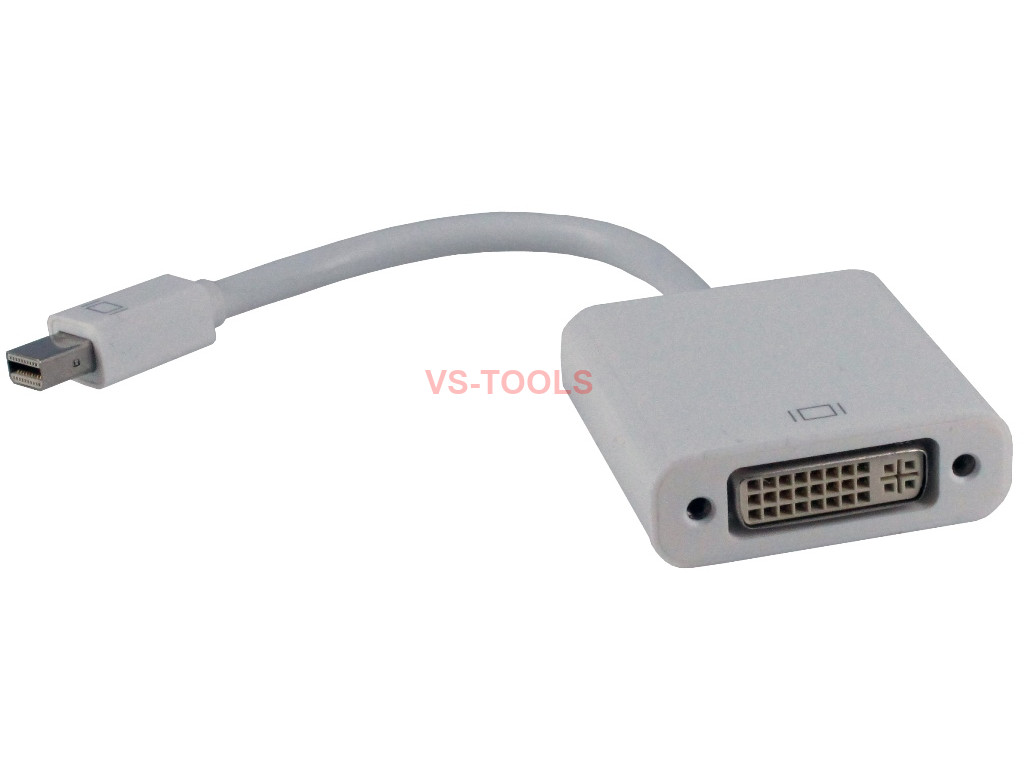
- Apple Mini-DVI to DVI Adapter (DVI-D) Apple part number M9321G/B (discontinued)
A non-OEM Mini-DVI to HDMI Adapter is also available on certain online stores such as eBay and Amazon, and from some retail stores, but not from Apple.

The physical connector is similar to Mini-VGA, but is differentiated by having four rows of pins arranged in two vertically stacked slots rather than the two rows of pins in the Mini-VGA.
Connecting to a DVI-I connector requires a Mini-DVI to DVI-D cable plus a DVI-D to DVI-I adapter.
Criticisms[edit]
- Apple's Mini-DVI to DVI-D cable does not carry the analog signal coming from the mini-DVI port on the Apple computer. This means that it is not possible to use this cable with an inexpensive DVI-to-VGA adapter for VGA output; Apple's mini-DVI to VGA cable must be used instead. This could be avoided if Apple provided a mini-DVI to DVI-I cable. The purpose of DVI-I is to ensure universal compatibility.[1][2]
- The Apple mini-DVI to DVI-D cable's package shows a DVI-I figure instead of DVI-D and does not specify that it comes with only DVI-D.
Mac Dvi Adapter
Compatibility[edit]
As Mini-DVI is pin-compatible with DVI, it supports both DVI and VGA through adapters.
See also[edit]
References[edit]
- ^'Blog explaining the difference'. Retrieved 2009-10-11.
- ^'Image showing the difference'. Retrieved 2009-10-11.
External links[edit]
Mac computers that have any of the following ports can connect to HDMI devices. Learn how to identify the ports on your Mac.
- HDMI port: Connects directly to HDMI using an HDMI cable.
- USB-C or Thunderbolt 3 (USB-C) port: Connects to HDMI using an adapter, such as the Apple USB-C Digital AV Multiport Adapter.
- Mini DisplayPort: Connects to HDMI using a third-party Mini DisplayPort to HDMI adapter or cable.
Mac computers that have an HDMI port comply with HDMI 1.4b and support:
- At least 1080p video over HDMI, and some Mac models support higher resolutions when connecting to 4K displays, 5K displays, and Ultra HD TVs
- 8-channel/24-bit audio at 192kHz, Dolby Surround 5.1, and traditional stereo
- HDCP-encrypted playback from iTunes and QuickTime Player (version 10). Safari in macOS Sierra or later also supports HDCP-encrypted playback, if the web page is HTML5-enabled and the content is FairPlay Streaming-enabled and delivered using Media Source Extensions or HTTP Live Streaming.
If using an adapter, check the specifications of the adapter to learn about supported resolutions and other details.
After making the connection

If your Mac doesn't recognize your HDTV, display, or other HDMI device after making the connection:
- Turn off the HDMI device while your Mac is turned on.
- Unplug the HDMI cable from your Mac, then plug it in again.
- Turn on the HDMI device.
If the video on your HDTV or display extends beyond the borders of the screen, open Displays preferences and adjust the Underscan slider for a better fit. Use any of these methods to open Displays preferences:
- Choose Apple () menu > System Preferences, then click Displays.
- Press Shift-Command-A to open the Applications folder. Then double-click System Preferences, then click Displays.
- If your keyboard has brightness controls, press Option–Brightness Up or Option–Brightness Down.

If your HDMI device isn't receiving audio from your Mac:
- Choose Apple menu > System Preferences, then click Sound. In the Output pane, make sure that your HDMI device is selected.
- If you're connecting using a Mini DisplayPort adapter, make sure that your Mac can send audio over Mini DisplayPort.
- If you're connecting from a Mac mini, unplug any audio device that is plugged into your computer's Audio-Out port.
Mac Mini Hdmi Problems
If your Mac goes to sleep while a video is playing or paused, you might see an HDCP error. Quit the app that is playing the video, then open the app again. If the issue continues, choose Apple menu > System Preferences, then click Energy Saver and adjust the settings so that your display doesn't turn off.
Learn more
Dvi Or Hdmi For Mac Mini Adapter
- If your Mac has an HDMI port, you can use the Apple HDMI to DVI Adapter to connect to a DVI display.
- Mac computers don't support using CEC (Consumer Electronics Control) to control HDMI devices.